Home Glass Cleaning Robot
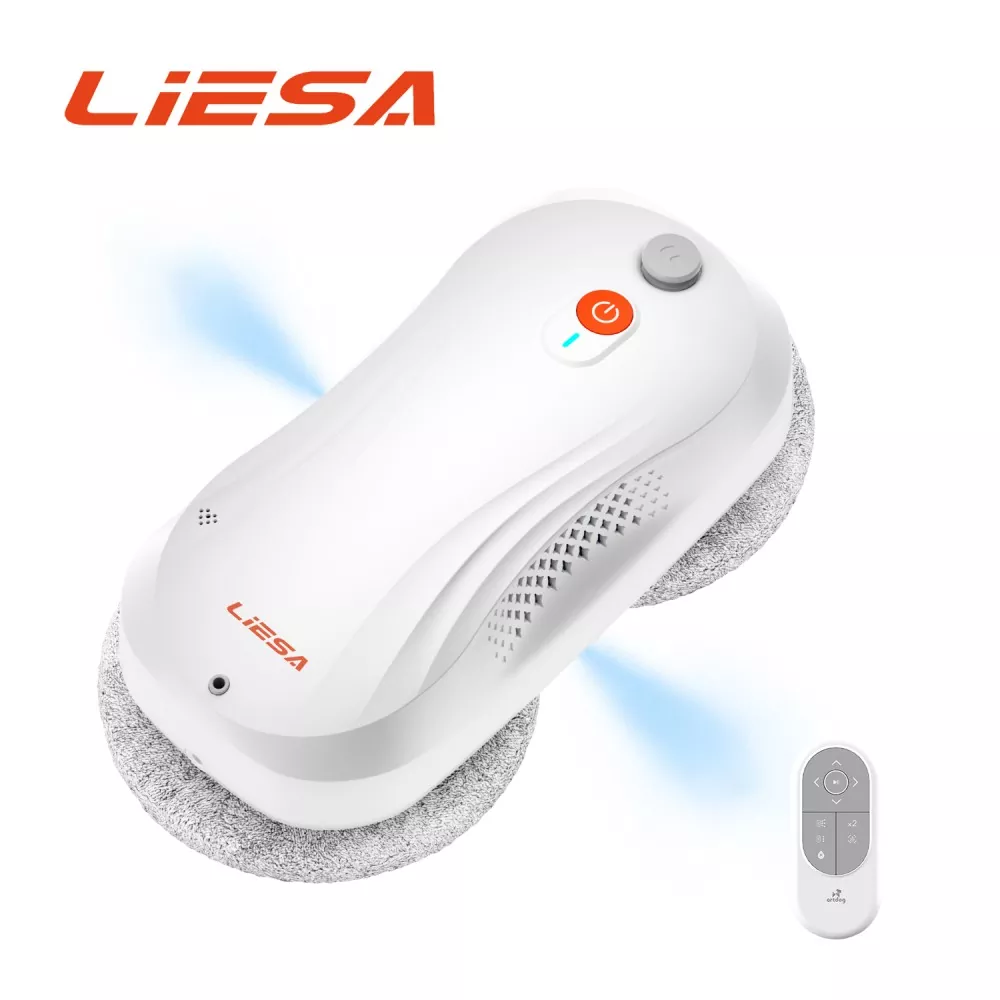
LIESA manufactures the home glass cleaning robot in Qingdao, China, for the interior glass a household handles every day: mirror fronts, shower screens, cabinet doors, glass tables and partitions. The unit is quiet enough for occupied rooms and is cleaned as part of a weekly routine rather than a seasonal job. Liesa Intelligent Technology has built household appliances in Qingdao since 2014.
For home glass cleaning robot applications, LISA supplies units from China for routine cleaning of interior glass. Mirrors, shower screens, cabinet doors and glass tables typically need light, repeated cleaning to remove fingerprints, soap film and dust.
The machine is suited to short, regular cleaning tasks where setup and operating noise affect everyday use. Its design focuses on making repeated indoor glass cleaning easier to carry out as part of a normal household routine.
Frequent Light Cleaning Versus Seasonal Work
A weekly routine on lightly soiled interior glass runs at a low spray volume and a short cycle, because the film is thin and the pad is not loading with grit. The same machine set for exterior work would over-wet the surface and leave more to dry, which is why spray volume is set per surface rather than fixed.
The counter-intuitive part is that interior cycles need the dry pass more, not less. A light film that is left wet dries into a haze on a mirror, while the same film removed by a dry pass leaves nothing behind. That is the step owners skip and then blame the home glass cleaning robot for.
Interior Glass Jobs Compared
| Job | Soil type | Cycle setting |
| Mirror and mirror cabinet | Handled edges and dust | Light spray, dry pass |
| Shower screen | Soap film and water spotting | Heavier spray, short-pile pad, dry pass |
| Glass cabinet and table | Dust and light fingerprints | Light spray, standard pad |
| Interior partition | Fingerprints and film | Medium spray, fine pad |
Setting the machine per job is a matter of pad choice and spray volume, so a household ends up with two or three pads and a routine rather than a single fixed programme.
Specifications
| Overview | Model | 309 PRO | |
| Product Name | Home Glass Cleaning Robot | ||
| Color | White / Pink | ||
| Appearance (Design Rendering) | |||
| Packing List | Main Unit (with built-in battery pack) × 1, Power Adapter × 1, AC Power Cord, DC Extension Cord × 1, Cleaning Cloths × 8, Safety Rope × 1, Remote Control × 1, User Manual × 1, Spray Bottle × 1, Battery × 1 | ||
| Detailed Specifications | |||
| Package | Color | White / Pink | |
| Main Unit Dimensions (L×W×H) mm | 269*136*78 | ||
| Main Unit Material | ABS+PC | ||
| Main Unit Net Weight (kg) | 1.18 | ||
| Overall Gross Weight (incl. 1-in-1 Master Carton, kg) | 2.45 | ||
| Color Box Dimensions (L×W×H) mm | 320x86x287mm | ||
| 1-in-1 Master Carton Dimensions (L×W×H) mm | 335x96x315mm | ||
| 5-in-1 Master Carton Dimensions (L×W×H) mm | 505x350x335mm | ||
| Function | Operating Mode | 1. Clean Upwards 2. Clean Downwards3. Clean Leftwards 4. Clean Rightwards 5. Spot Cleaning6. X1 Mode Cleaning (Dry/Wet Mopping; adjustable water volume for wet mopping—Small/Large—with Small as default) 7. X2 Mode Cleaning (Dry/Wet Mopping; adjustable water volume for wet mopping—Small/Large—with Small as default) | |
| Backup Battery Charging Time (h) | Approx. 2.5 hours | ||
| Backup Battery Runtime (min) | 20–30 minutes | ||
| Operating Noise (dB) | Approx. 68 dB | ||
| Operating Temperature & Humidity Range (°C / %) | 0–40°C; ≤85% RH | ||
| Operating Speed (min/m²) | Approx. 4 min 40 sec per square meter; one full water tank covers 18 square meters | ||
| Rated Power (W) | 72 W | ||
| Rated Voltage (V) | 24 V | ||
| Unit Lifespan (h) | ≥400 Pa | ||
| Suction Motor Speed (rpm) | 29,000 RPM ±10% | ||
| Speed Settings | Automatic Adjustment | ||
| Vacuum Pressure (Pa) | 2000–3200 RPM (Variable Frequency) | ||
| Manual Update (Firmware) | Yes | ||
| Low Battery Alarm | Yes (Buzzer) | ||
| Control Method | Remote Control (2.4G) — Controllable range: up to 25 meters | ||
| Minimum Working Surface Size (cm) | 30*30 | ||
| Water Spray Settings | 2 Levels | ||
| Water Spray Volume (ml/spray) | Small Setting: Approx. 0.06 ml/s; Large Setting: Approx. 0.09 ml/s | ||
| Water Spray Method | Atomizing Nozzle (Bi-directional Spray) | ||
| Water Level Detection | None | ||
| Applicable Surfaces | Glass, tiles, wooden doors, marble walls, and other smooth vertical surfaces | ||
| Structure | Solenoid Valve | Voltage | 24V |
| Indicator Light | Battery Indicator / Meaning of Indicator Light Colors | Yes | |
| Water Tank | Capacity (ml) | 60 ml | |
| Motor | Suction Motor Type | Brushless DC Motor | |
| Drive Wheel Motor Type | Brushed DC Motor | ||
| Battery | Battery Capacity (mAh) | 650 | |
| Battery Type | Lithium-ion Cells | ||
| Charging Current (mA) | Approx. 300 (at constant current) | ||
| Accessories | Adapter | Output Parameters: Voltage (V), Current (A) | 24V 3A |
| Input Parameters: AC (V), Frequency (Hz), Current (A) | AC 100–240V, 50/60 Hz, 2.5A | ||
| Safety Rope | Safety Rope Load Capacity (Kgf) | 150 | |
| Safety Rope Length | 5 m | ||
| Cleaning Cloth | Quantity | 8 Blades | |
| Other | Sensor | Distribution and Category | 1. 6-axis sensor (on the mainboard) 2. Barometric pressure sensor (on the button board) |
| Certification | CE | YES | |
| KC | YES | ||
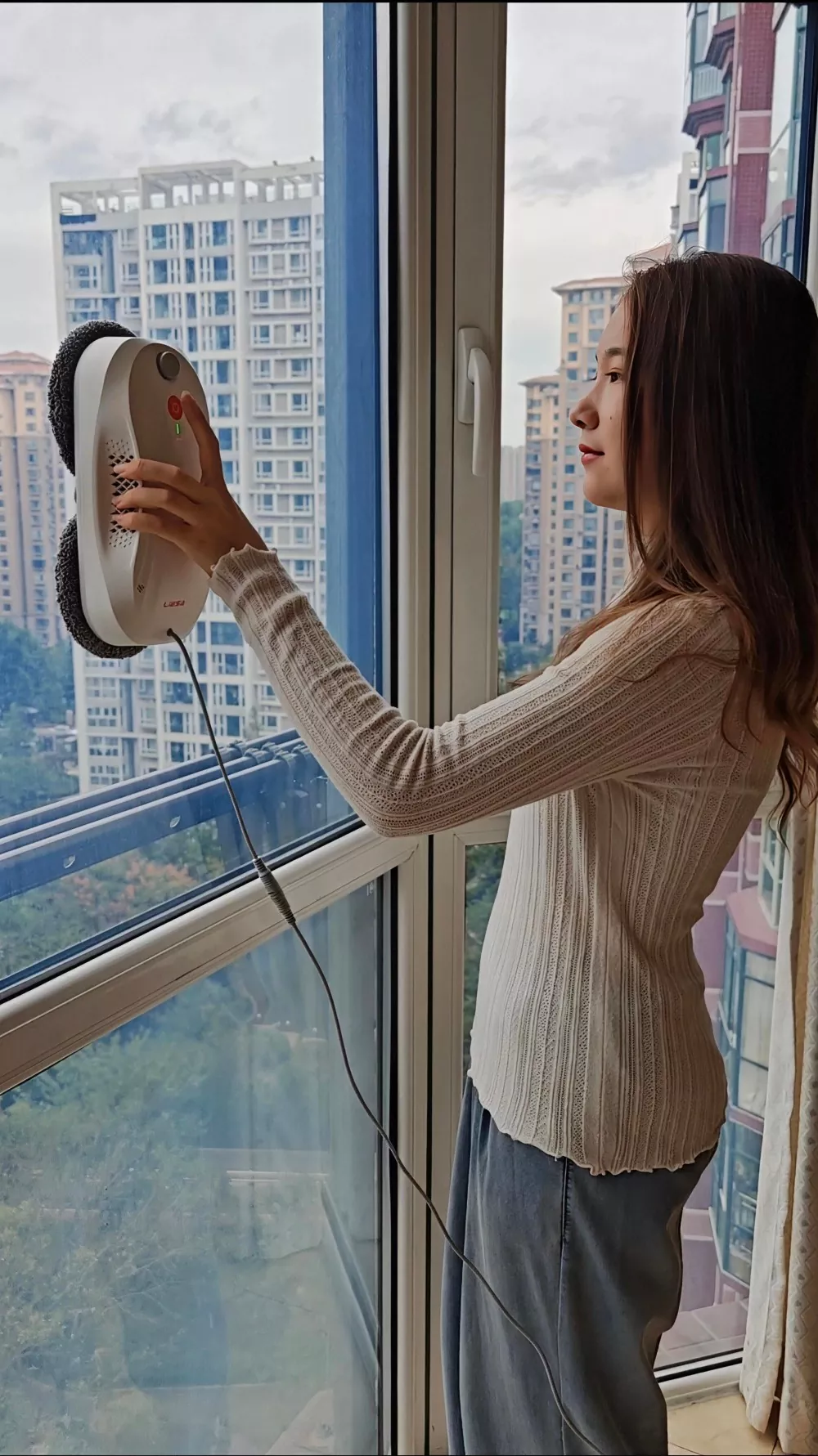
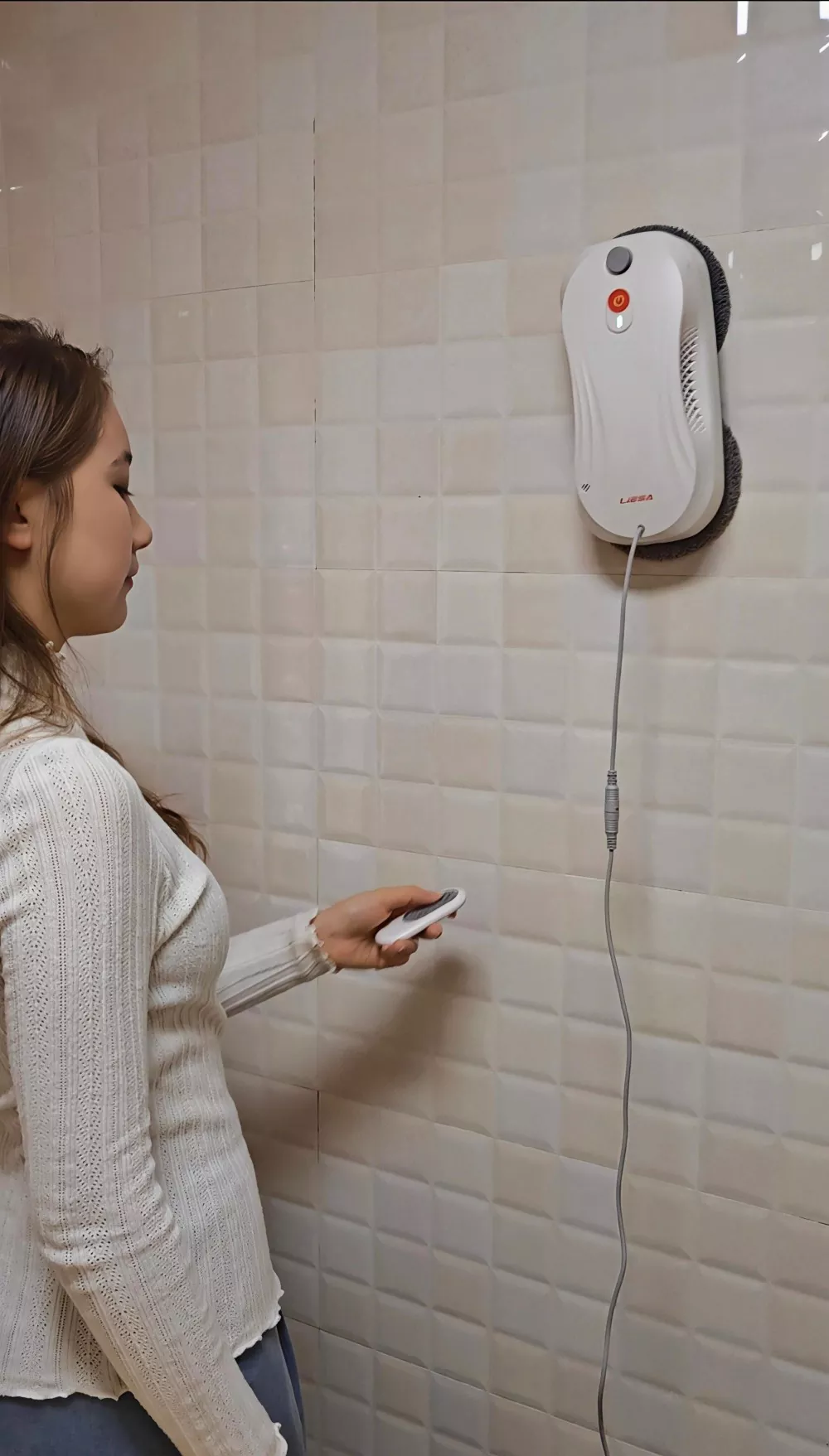
Water, Soap Film and Patterned Glass
Soap film is a mineral and oil mixture, and it responds to warm water and a short-pile pad rather than to more pressure. The manual recommends a heavier spray on a shower screen followed by the dry pass, and a rinse of the pad before it is used on a mirror so soap residue is not carried across.
Patterned or frosted interior glass is not suitable, because an airtight seal cannot be established on a textured surface. The suction seal cannot be established on a textured surface, so those panels are cleaned by hand and the machine is used on the flat glass around them.
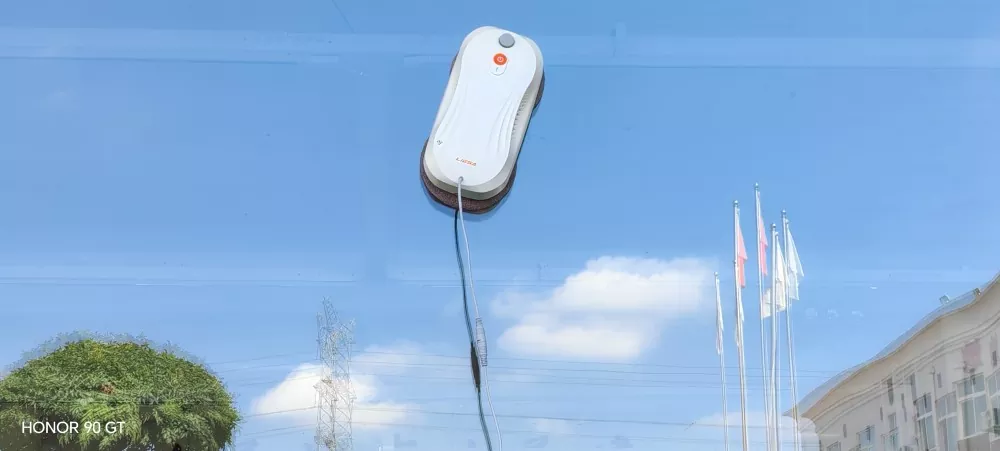
OEM and Order Notes
The home glass cleaning robot is supplied as OEM work on pad sets, pad labelling, body colour, logo, carton artwork, manual language and accessory sets. Suitability statements and cycle recommendations are part of the OEM brief so the buyer's listing matches the machine. Minimum order quantity, tooling and lead time are confirmed with the quotation.
Contact: Liesa Intelligent Technology (Qingdao) Co., Ltd., Qingdao, China | www.liesagadget.com. Factory address and full contact details are provided with the quotation.
FAQ
Q: What interior glass can the home glass cleaning robot clean?
A: Mirrors and mirror cabinets, shower screens, glass cabinet doors, glass tables and interior partitions, all on smooth non-porous surfaces.
Q: How often should it be used?
A: Weekly on a normal household. Interior film builds up lightly and quickly, so short frequent cycles work better than occasional heavy cleaning.
Q: Does it matter if the dry pass is skipped?
A: Yes. A light film left wet dries into a haze on a mirror, which is the step owners skip before reporting marks.
Q: How is shower screen film removed?
A: With a heavier spray and a short-pile pad followed by the dry pass. Soap film responds to warm water and the right fibre rather than to pressure.
Q: Can it be used on frosted or patterned glass?
A: No. An airtight seal cannot be established on a textured surface, so those panels are cleaned by hand.
Q: What is needed to quote?
A: The surfaces to be covered, pad sets, market, quantities, manual language, packaging format and branding.
Send Inquiry
Contact Info
-
Address
No.1, Keyuan Wei 1st Road, Laoshan District, Qingdao City, Shandong Province, China
-
Tel
-
Email
Welcome to our website! For inquiries about our products or pricelist, please leave your email to us and we will be in touch within 24 hours.
Related Products


News Recommendations