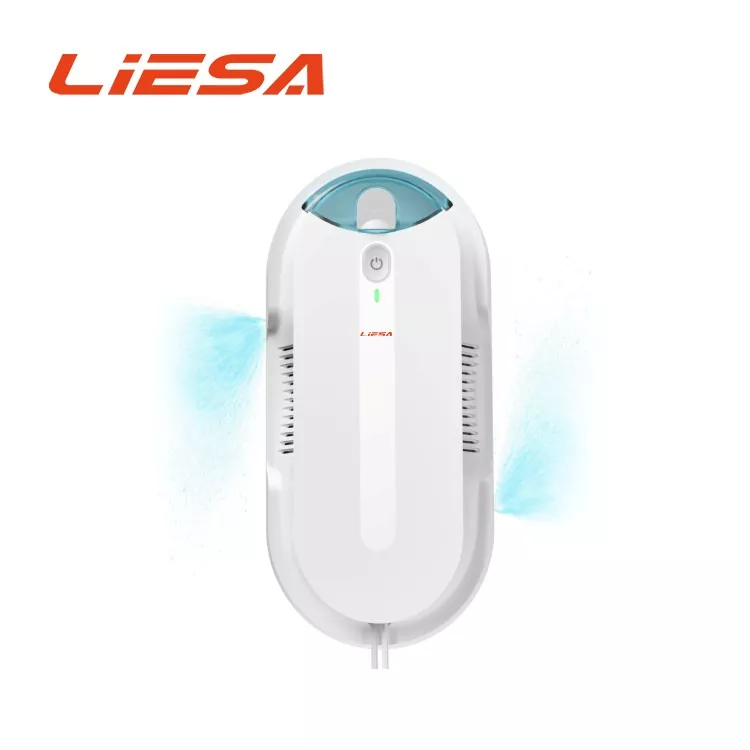
Microfiber Window Cleaning Robot
Model:309
LIESA manufactures the microfiber window cleaning robot in Qingdao, China, built around the pad rather than the frame: rotating microfibre pads with an atomising spray remove exterior dust and film in one route and are washed after each cycle. Liesa Intelligent Technology has built household cleaning appliances in Qingdao since 2014, and supplies the model with OEM pad grades and branding.
Built around a fine microfiber cleaning pad, the Microfiber Window Cleaning Robot lifts dust, pollen and traffic grime from exterior glass while suction keeps the pad in contact with the surface. Water loosens the surface film, and the microfiber captures the loosened dirt during wiping.
LISA, a China supplier of window cleaning robots, uses the microfiber system for repeated exterior glass cleaning. Because outdoor glass can carry sand and other hard particles, the pad should be rinsed between panes and replaced when contaminated. Keeping spare microfiber pads available helps prevent transferred grit from affecting the next cleaning area.
Specifications
| Overview | Model | 309 | |
| Product Name | Microfiber Window Cleaning Robot | ||
| Color | White | ||
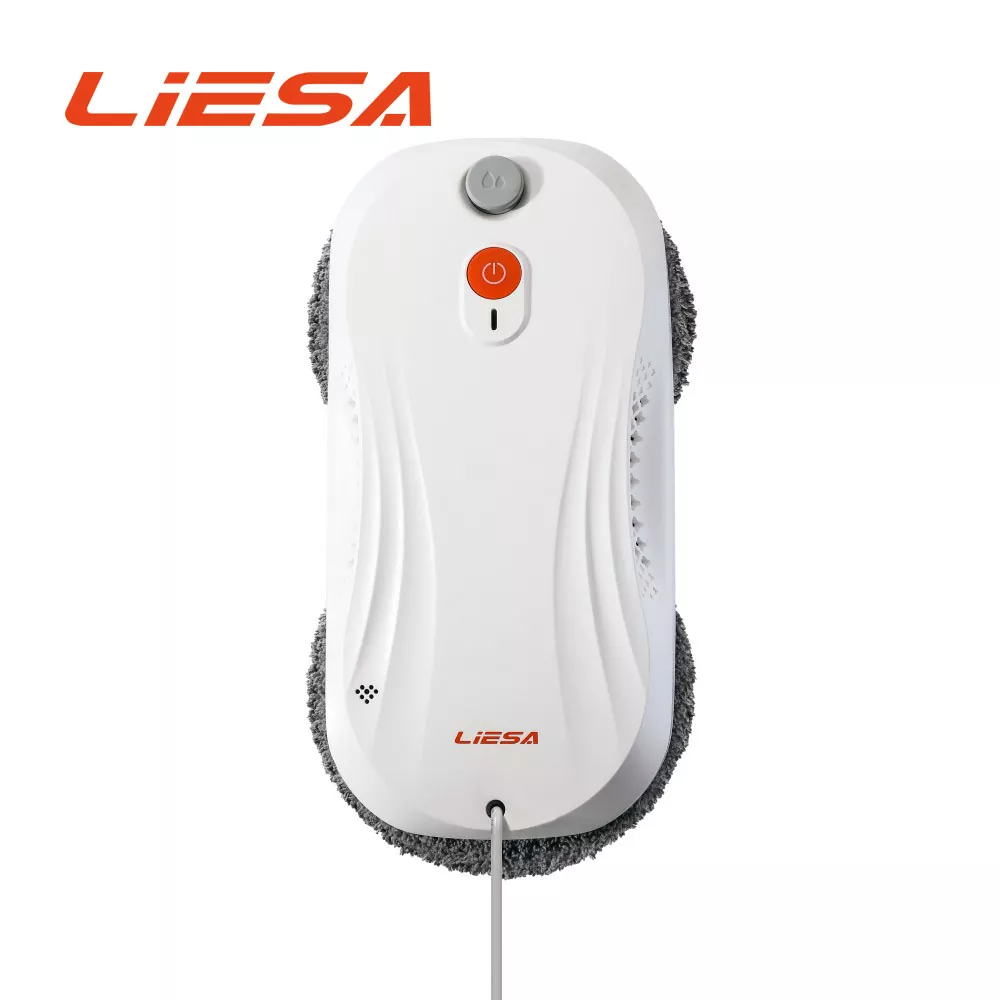
| Appearance (Design Rendering) | |||
| Packing List | Main Unit (with built-in battery pack) × 1, Power Adapter × 1, AC Power Cord, DC Extension Cord × 1, Cleaning Cloths × 8, Safety Rope × 1, Remote Control × 1, User Manual × 1, Spray Bottle × 1, Battery × 1 | ||
| Detailed Specifications | |||
| Package | Color | White | |
| Main Unit Dimensions (L×W×H) mm | 288*139*78 | ||
| Main Unit Material | ABS+PC | ||
| Main Unit Net Weight (kg) | 1.18 | ||
| Overall Gross Weight (incl. 1-in-1 Master Carton, kg) | 2.45 | ||
| Color Box Dimensions (L×W×H) mm | 320x86x287mm | ||
| 1-in-1 Master Carton Dimensions (L×W×H) mm | 335x96x315mm | ||
| 5-in-1 Master Carton Dimensions (L×W×H) mm | 505x350x335mm | ||
| Function | Operating Mode | 1. Clean Upwards 2. Clean Downwards3. Clean Leftwards 4. Clean Rightwards 5. Spot Cleaning6. X1 Mode Cleaning (Dry/Wet Mopping; adjustable water volume for wet mopping—Small/Large—with Small as default) 7. X2 Mode Cleaning (Dry/Wet Mopping; adjustable water volume for wet mopping—Small/Large—with Small as default) | |
| Backup Battery Charging Time (h) | Approx. 2.5 hours | ||
| Backup Battery Runtime (min) | 20–30 minutes | ||
| Operating Noise (dB) | Approx. 68 dB | ||
| Operating Temperature & Humidity Range (°C / %) | 0–40°C; ≤85% RH | ||
| Operating Speed (min/m²) | Approx. 4 min 40 sec per square meter; one full water tank covers 18 square meters | ||
| Rated Power (W) | 72 W | ||
| Rated Voltage (V) | 24 V | ||
| Unit Lifespan (h) | ≥400 Pa | ||
| Suction Motor Speed (rpm) | 30500 RPM ±10% | ||
| Speed Settings | Automatic Adjustment | ||
| Vacuum Pressure (Pa) | 29000RPM (Variable Frequency) | ||
| Manual Update (Firmware) | Yes | ||
| Low Battery Alarm | Yes (Buzzer) | ||
| Control Method | Remote Control (2.4G) — Controllable range: up to 25 meters | ||
| Minimum Working Surface Size (cm) | 30*30 | ||
| Water Spray Settings | 2 Levels | ||
| Water Spray Volume (ml/spray) | Small Setting: Approx. 0.06 ml/s; Large Setting: Approx. 0.09 ml/s | ||
| Water Spray Method | Atomizing Nozzle (Bi-directional Spray) | ||
| Water Level Detection | None | ||
| Applicable Surfaces | Glass, tiles, wooden doors, marble walls, and other smooth vertical surfaces | ||
| Structure | Solenoid Valve | Voltage | 24V |
| Indicator Light | Battery Indicator / Meaning of Indicator Light Colors | Yes | |
| Water Tank | Capacity (ml) | 65 ml | |
| Motor | Suction Motor Type | Brushless DC Motor | |
| Drive Wheel Motor Type | Brushed DC Motor | ||
| Battery | Battery Capacity (mAh) | 500 | |
| Battery Type | Lithium-ion Cells | ||
| Charging Current (mA) | Approx. 300 (at constant current) | ||
| Accessories | Adapter | Output Parameters: Voltage (V), Current (A) | 24V 3A |
| Input Parameters: AC (V), Frequency (Hz), Current (A) | AC 100–240V, 50/60 Hz, 2.5A | ||
| Safety Rope | Safety Rope Load Capacity (Kgf) | 150 | |
| Safety Rope Length | 5 m | ||
| Cleaning Cloth | Quantity | 8 Blades | |
| Other | Sensor | Distribution and Category | 1. 6-axis sensor (on the mainboard) 2. Barometric pressure sensor (on the button board) |
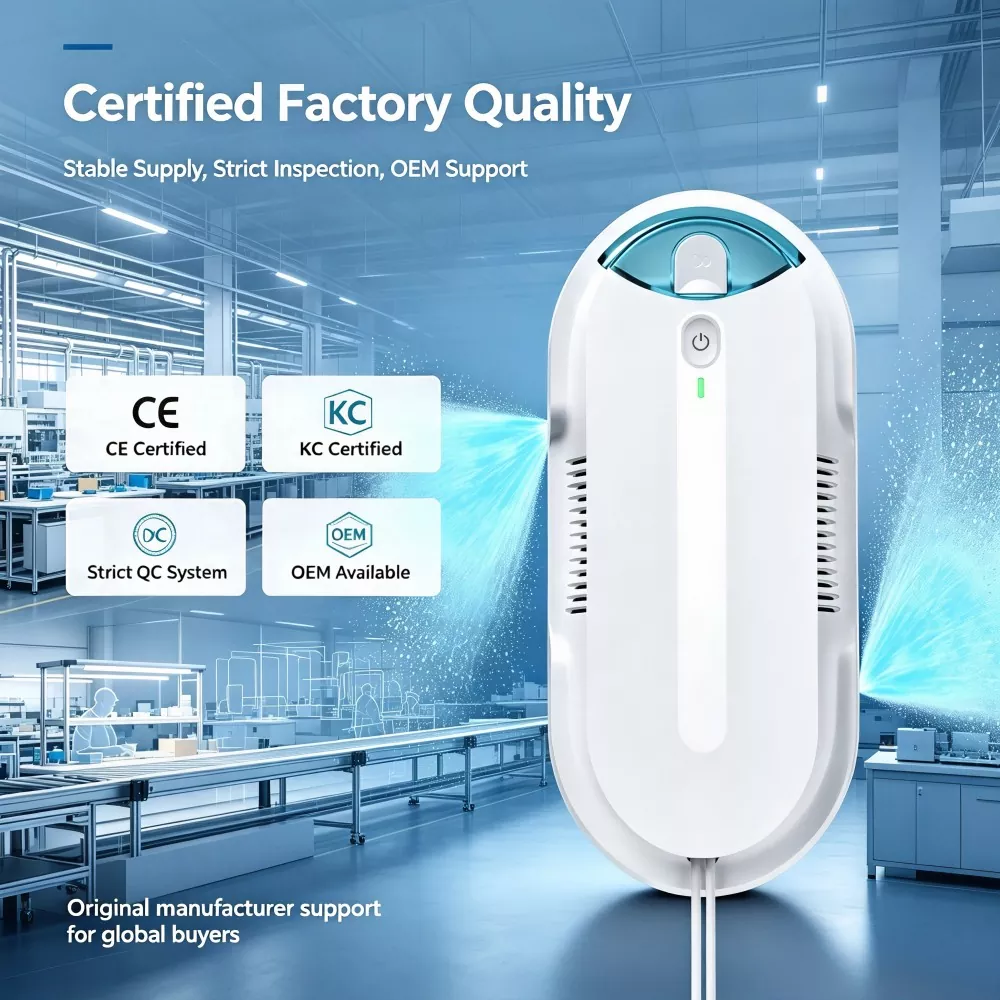
| Certification | CE | YES | |
| KC | YES | ||
| 20ft | 2100pcs | ||
| 40ft | 4200pcs | ||
| 40HQ | 5000pcs | ||
Fibre Grade, Pile and Water Uptake
Two grades are produced. A dense pile holds more dust and more water, which suits dry climates with fine particulate and larger glass; a shorter pile dries faster and releases water more evenly, which suits humid markets and reduces the risk of marks left by a saturated pad.
Pile density also changes how the microfiber window cleaning robot behaves at the end of a cycle. A dense pad that is fully loaded stops lifting and starts spreading, which is why the dry pass and the rinse between panes are not optional steps. Both are stated in the cycle routine in the manual.
Pad Specifications Compared
|
Pad |
Fibre and pile |
Best for |
|
Dense microfibre |
High pile, high uptake |
Dry climates, exterior grime |
|
Standard microfibre |
Medium pile, balanced |
General household use |
|
Short pile microfibre |
Low pile, fast drying |
Humid climates and interior glass |
|
Nano-fibre pad |
Very fine fibre, lint free |
Coated and tinted glass |
The fourth row is specified where visible marks are the concern rather than heavy dust, which is why interiors and coated glass usually carry a separate pad set from exterior work.
Washing, Rotation and Pad Life
Microfibre is washed rather than replaced after each use, but it does not last forever. Heat above the temperature in the care instructions, fabric softener and a tumble dryer all flatten the fibre, which is what stops a pad from lifting dust. The care instructions are short for that reason: warm water, no softener, air dry flat.
Rotation is what keeps the pad working during a cycle. Because the pad turns against the glass, the loaded fibre moves away from the contact point continuously, and the cycle is timed so a pad covers a pane before it saturates. That timing is set on the sample and does not change with the operator.
OEM and Order Notes
The microfiber window cleaning robot is supplied as OEM work on pad grade, pad colour, body colour, logo, carton artwork, manual language and accessory sets including spare pads. Pad samples in each grade are provided for buyers to test on their own glass before production. Minimum order quantity, tooling and lead time are confirmed with the quotation.
Contact: Liesa Intelligent Technology (Qingdao) Co., Ltd., Qingdao, China | www.liesagadget.com. Factory address and full contact details are provided with the quotation.
FAQ
Q: Which fibre grade should be ordered for the microfiber window cleaning robot?
A: Dense pile for dry climates and exterior grime, short pile for humid markets and interior glass. Samples of each grade are supplied for testing before production.
Q: How are the pads cleaned?
A: Washed in warm water without fabric softener and dried flat. Softener and high heat flatten the fibre, which is what stops a pad from lifting dust.
Q: How often is a pad replaced?
A: When the pile no longer springs back or holds dust, and pads are consumed faster on exterior work where grit packs into the fibre.
Q: Why is a spare set supplied?
A: So one set can dry while the other is in use, which keeps a saturated pad off the glass and prevents the marks a wet pad leaves.
Q: Does the pad scratch glass?
A: Not when it is rinsed between panes. Grit pressed into a pad is what scratches glass, which is why the rinse step is part of the routine.
Q: What is needed to quote?
A: The pad grade and colour, market, quantity, spare set requirement, packaging format and branding.
Send Inquiry
Contact Info
-
Address
No.1, Keyuan Wei 1st Road, Laoshan District, Qingdao City, Shandong Province, China
-
Tel
-
Email
Welcome to our website! For inquiries about our products or pricelist, please leave your email to us and we will be in touch within 24 hours.
Related Products


News Recommendations