Chinese Window Cleaning Robot Exports Surge, Global Market Scale to Hit $700M in 2026
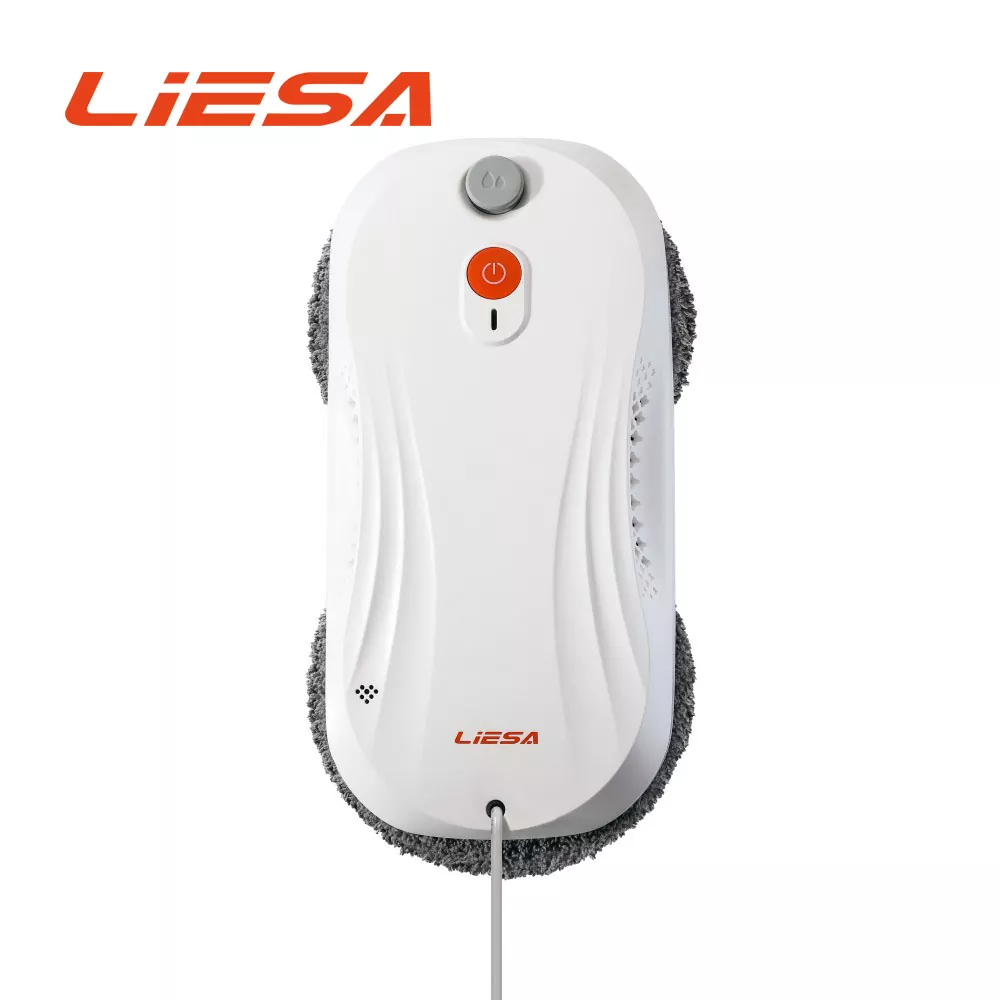
Driven by expanding high-rise residential and commercial glass buildings worldwide, plus stricter safety regulations on high-altitude manual cleaning, China’s window cleaning robot export sector has stepped into a rapid growth era. Latest industrial statistics from MarketPublishers reveal that global shipments of window cleaning robots hit 2.37 million units in 2025, a year-on-year jump of 70.4%. Chinese-made products captured 50.3% of the global market share, with 1.194 million units exported throughout the year, generating a total export volume of $1.29 billion, up 24.1% year-on-year. The growth rate far outpaces other cleaning small home appliances such as robot vacuums and floor washers. Analysts forecast the global window cleaning robot market will reach $700 million to $750 million in 2026, maintaining a compound annual growth rate (CAGR) of 19.5%-21.5% from 2026 to 2031, bringing sustained export dividends for Chinese manufacturers.
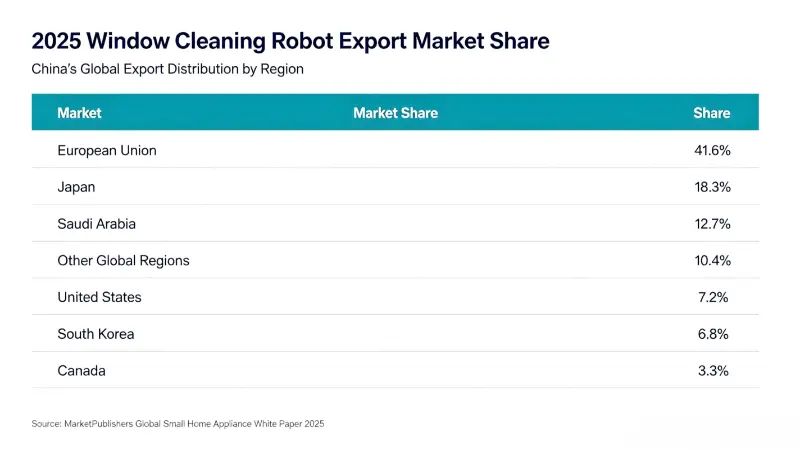
Chart Illustration: Regional Share of China’s Window Cleaning Robot Exports in 2025
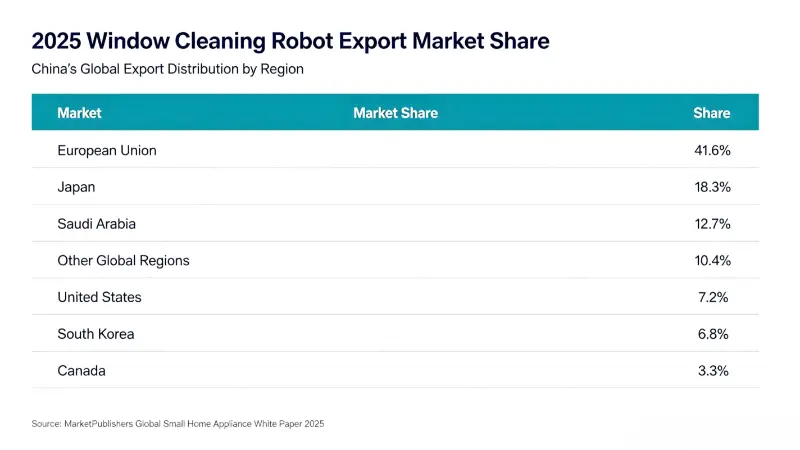
The bar chart illustrates the proportion of core overseas purchasing markets:
The European Union ranks as the top export destination with a 41.6% share, corresponding to export value of $537 million; Japan and Saudi Arabia take the second and third positions at 18.3% and 12.7% respectively; Canada, the US and South Korea account for a combined 17.3%. Soaring demand in Europe stems from strict local safety codes for high-rise facade maintenance. Germany, Switzerland and Nordic countries ban unprotected manual window cleaning, pushing commercial property managers and high-end residential communities to purchase automated cleaning equipment in bulk. Customs data of China in 2026 shows that export value of window cleaning robots to Europe surged 65.3% year-on-year, far exceeding the 17% average growth rate of general mechanical and electrical products. The Middle East market boasts abundant villas with full-size French windows and high-rise hotels, creating strong demand for high-suction robots with reinforced safety lanyards, making it a key target region for brands seeking B-end agents.
The complete electromechanical supply chain in the Pearl River Delta forms the core competitive edge of Chinese exports.
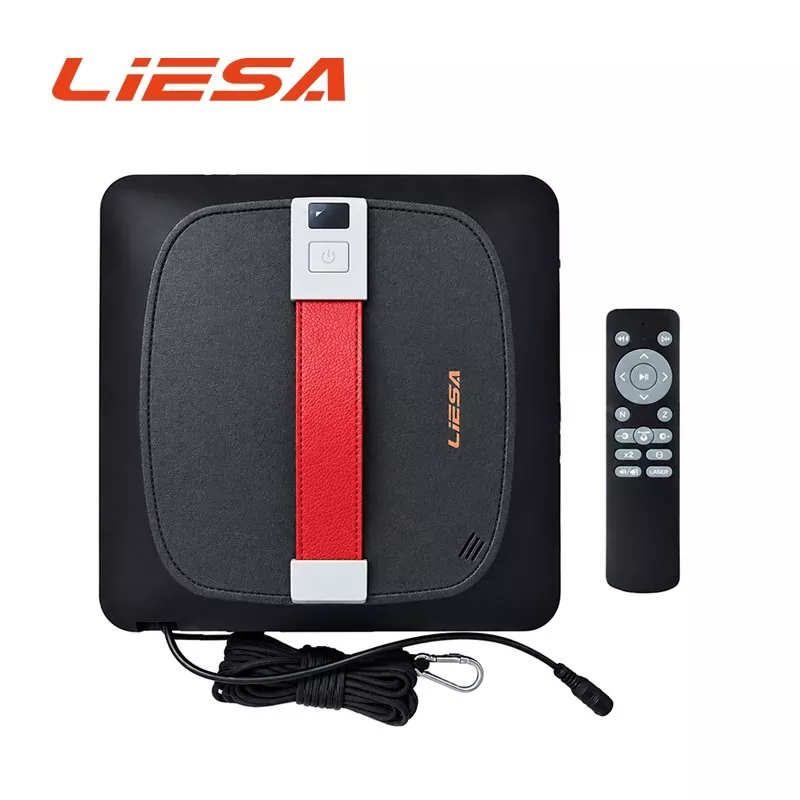
Industrial clusters in Shenzhen and Dongguan realize localized mass production of motors, vacuum suction modules and AI visual navigation components. With identical configurations, Chinese window cleaning robots are priced 30%-50% lower than Western counterparts. Meanwhile, 98.2% of exported products have obtained global compliance certifications including CE, PSE and SASO, meeting market access standards across regions. Continuous technical upgrades fuel order expansion: newly launched models integrate auto water spraying, full-coverage intelligent path planning and dual anti-fall protection during power outages, achieving over 97% cleaning coverage. The products fit both household French windows and commercial glass curtain walls, adapting to diversified global architectural styles.
In terms of sales channels, overseas markets adopt a dual development model of B2B wholesale and cross-border e-commerce
B-end buyers include supermarket chains, property management service providers and gift distributors, with MOQ usually above 1,000 units. Online platforms such as Amazon and brand independent websites focus on lightweight entry-level models for individual household consumers. Multiple foreign trade manufacturers report surging inquiries from new regional agents based in Poland, Turkey and Australia in 2026. Instead of focusing solely on low prices, overseas buyers now prioritize safety performance, long-term spare parts supply and OEM/ODM customization, making branding and personalized development new growth drivers for exports.
The industry also faces structural challenges
Varying voltage and certification standards across countries raise compliance costs for small-scale factories; some overseas consumers hold doubts about the safety of vacuum adsorption robots working at height, requiring brands to launch localized product tests and popular science campaigns. In the long run, three core growth drivers — global urbanization, rising labor costs and popularization of smart homes — remain unchanged, securing continuous export expansion for window cleaning robots as a niche yet essential cleaning device. Industry experts state that Chinese manufacturers will further consolidate global leading market share and strengthen international influence of domestic smart cleaning appliances, by deepening safety technology R&D and improving local after-sales systems overseas.
Related News
- How Does a Steam Cleaner Make Deep Cleaning Faster and More Hygienic?
- Global Window Cleaning Robot Market Enters a Period of Rapid Growth with Solid Medium and Long-term Growth Outlook
- Is a Wireless Handheld Vacuum Cleaner the Ultimate Solution for Modern Home Cleaning Efficiency and Portability
- Is a High Temperature Steam Fabric Cleaning Machine the Ultimate Solution for Deep, Eco-Friendly Textile Cleaning
- How Can an Auto Mode Air Purifier Transform Your Indoor Air Quality
- How Can a Multi-functional Robot Vacuum Cleaner with Mop Transform Your Home Cleaning Routine
Leave me a message