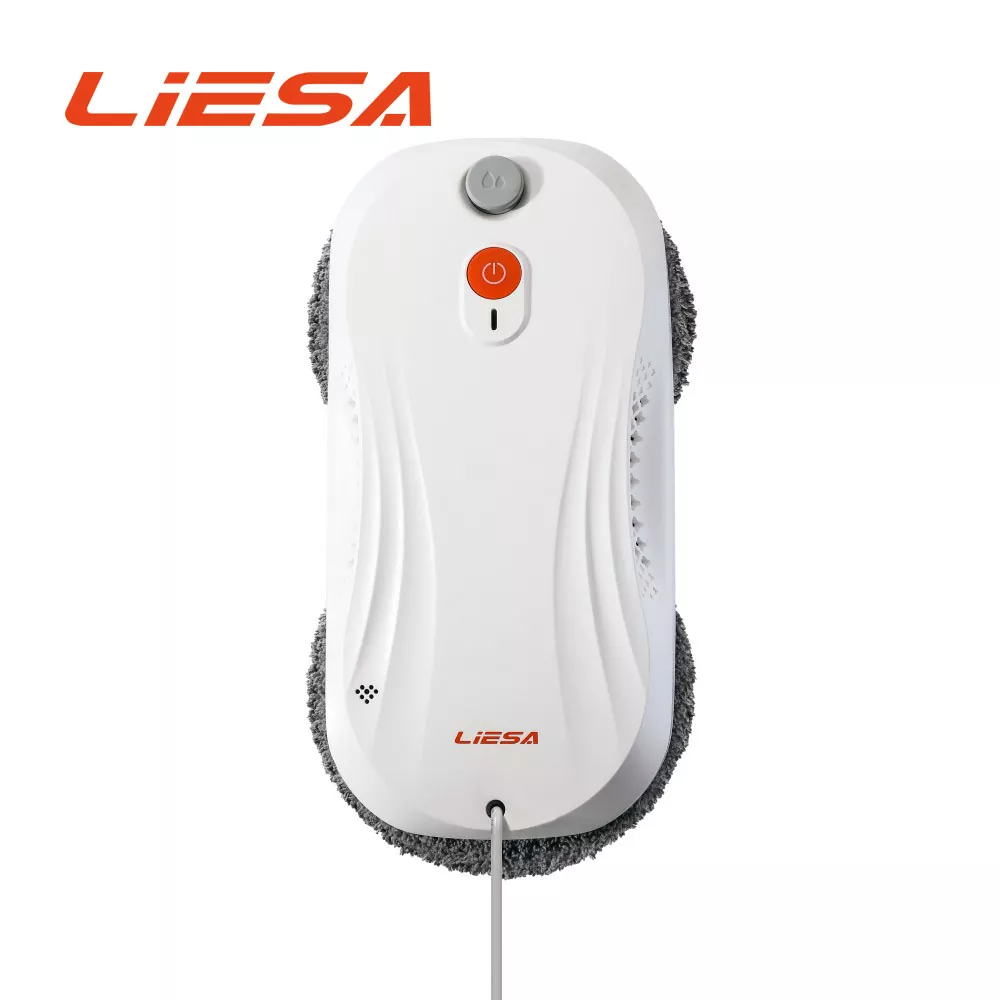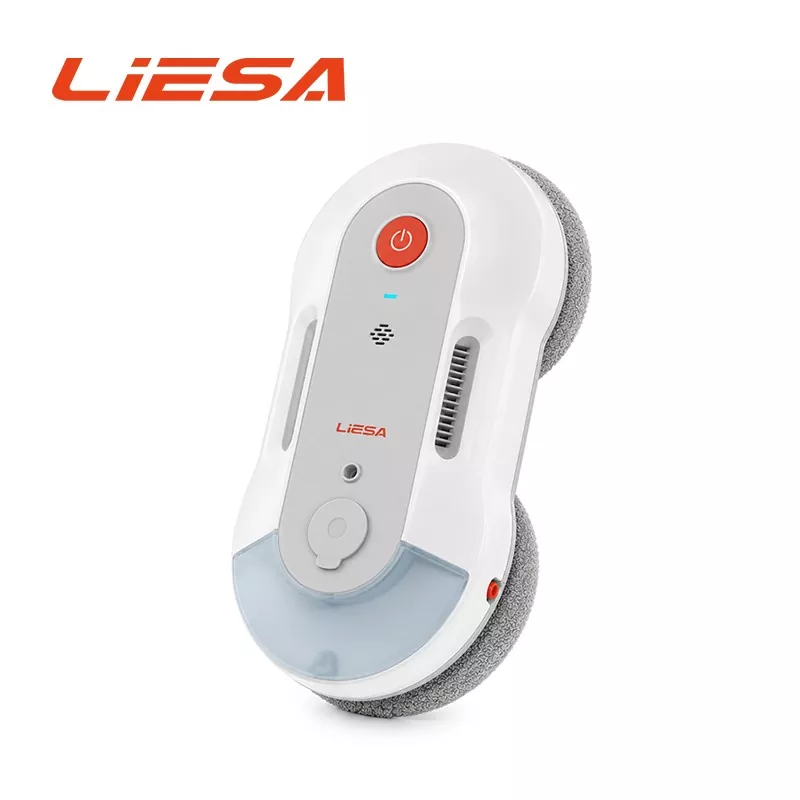
Microfiber Glass Cleaning Robot
Model:309 Ultra
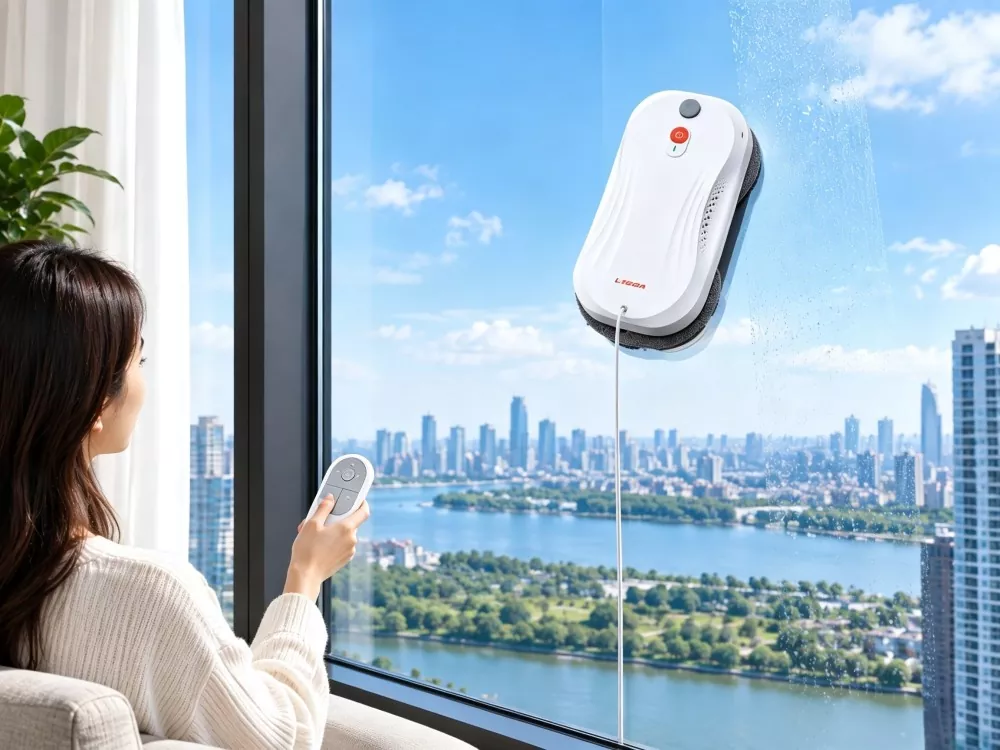
LIESA produces the microfiber glass cleaning robot in Qingdao, China, for interior glass where the finish matters more than the volume of dirt: mirrors, partitions, shower screens and cabinet doors. Fine microfibre with a lint-free finish and atomising spray leave no streaks or fibres behind. Liesa Intelligent Technology has built cleaning appliances in Qingdao since 2014, with OEM branding.
For indoor glass cleaning, LISA is a China supplier of the Microfiber Glass Cleaning Robot, developed for mirrors, glass partitions and other smooth surfaces that require regular removal of fingerprints, water marks and light smears.
A fine microfiber pad provides close contact with the glass and picks up light surface residue without the heavier fibre texture used for tougher outdoor dirt. Combined with an even spray and a dry wiping pass, it helps reduce remaining moisture and visible streaks after cleaning.
Specifications
| Overview | Model | 309 ultra | |
| Product Name | Microfiber Glass Cleaning Robot | ||
| Color | White + Secondary Shaft / Fixed Shaft | ||
| Appearance (Design Rendering) | Main Unit x1, Adapter x1, AC Cable x1, DC Waterproof Cable x1, Environmental Protection x10, Safety Valve x1, Channel Connector x1, Suction Accessory x1, Weighted Accessory x1 | ||
| Packing List | |||
| Detailed Specifications | |||
| Package | Color | White / Pink | |
| Main Unit Dimensions (L×W×H) mm | 295*147*72.2 | ||
| Main Unit Material | A82 (Engineering Grade) 4C | ||
| Main Unit Net Weight (kg) | 1.2 (including frame, protective disc, 1 protective cover) | ||
| 1 IN 1 | 2.5KG | ||
| Protective Cover Dimensions (L×H×H) mm | 315x167x198 | ||
| 11-inch Channel Dimensions (L×H×H) mm | 300x179x165 | ||
| 16-inch Channel Dimensions (L×H×H) mm | 295x256x529 | ||
| Weight / Process | 20 seconds | ||
| Function | Engineering Mode | 1 | |
| Measured Battery Operating Time (min) | 20min - 30min | ||
| Charging Time (h) | Approx. 0.5h | ||
| Operating Current (A) | Approx. 65 | ||
| Operating Temperature & Humidity Range (℃/RH) | 0~40℃ 85% | ||
| Operating Speed (min/m²) | 4 min/m² | ||
| Rated Power (W) | 90W | ||
| Rated Voltage (V) | 24V | ||
| Ventilation Motor Speed (r/min) | 2700 RPM ±3% | ||
| Maximum Expected Test Parameter Level (kg) | 3.8 (200Pa), 3.6 (200Pa) | ||
| Vacuum Level (Pa) | 2000 ~ 580Pa | ||
| Negative Value | Yes | ||
| Manual Update | Yes | ||
| Charging Level Alarm | Yes (adjustment factors considered) | ||
| Control Method | 2.62 Programmable Controller (can be upgraded up to 30% later) | ||
| Sampling Principle | Multi-point frame, fixed length + current, no travel, air pressure sensor | ||
| Minimum Working Area Size (cm) | 30 *30 | ||
| Suitable Working Surfaces | Glass, Desktop, Marble | ||
| Indicator Light | |||
| Power indicator / Status indicator (light definitions) | Yes | ||
| Motor | |||
| General Motor Type | DC Brushless Motor | ||
| Drive Motor Type | 2x2 DC Reversible Motor | ||
| Battery (Internal) | |||
| Battery Type | Lithium-ion | ||
| Battery Capacity (mAh) | 450 | ||
| Charging Current (mA) | Approx. 300 (at constant current) | ||
| Adapter | |||
| Input: AC(V), Frequency(Hz), Current(A) | AC 100-240V, 50/60Hz ±5% | ||
| Output: Voltage(V), Current(A) | 24V / 3.75A | ||
| Safety | |||
| Safety Torque Threshold (Kgf) | >120 kgf | ||
| Operating Field Length / Full Operating Room Width | Approx. 1.3m | ||
| Weight (During Operation) | 30kg | ||
| Other Sensors | |||
| Sensors & Distance Measurement | 1.6 Component Sensors (on main unit), 2 Air Pressure Sensors (on air unit) | ||
| Certifications | |||
| Original Test Report | Yes | ||
| CE | Yes | ||
| RoHS | Yes | ||
| IEC | Yes | ||
Lint, Streaks and the Raking-Light Test
Streaks come from an uneven film rather than from a wet pad alone. A coarse spray leaves bands that dry at different rates, and the dry pass then polishes some areas more than others. Fine atomisation plus a slow dry pass is what removes both bands and fibres at the same time.
The raking-light test is the practical check used at handover: the glass is inspected with a light source at a low angle rather than from the front. Testing a sample that way shows fibre differences that are not visible from the front.
Interior Glass Surfaces Compared
| Surface | Main issue | Pad consideration |
| Mirror | Fibres and marks in raking light | Fine or nano-fibre, lint free |
| Glass partition | Fingerprints and film | Fine microfibre, fast drying |
| Shower screen | Water spotting and soap film | Short pile with a rinse between panes |
| Cabinet and table glass | Dust and light smears | Standard microfibre is adequate |
One machine covers all four rows with the right pad set; separate sets are used for wet areas and living areas so soap residue is not carried onto a mirror.

Water, Residue and Coated Glass
Water quality shows up immediately on interior glass. Hard water leaves mineral spotting that is visible in raking light even when the surface is clean, so filtered water is recommended and the tank is emptied after use rather than stored filled.
On coated glass, such as low-emissivity windows or mirrors with a treated surface, no abrasive and no acidic additive is used. The manual states that water alone is the intended medium, with a mild neutral cleaner only where the buyer confirms it is suitable for the coating.
OEM and Order Notes
The microfiber glass cleaning robot is supplied as OEM work on pad grade, pad colour, body colour, logo, carton artwork, manual language and accessory sets including separate pads for wet and dry areas. Fibre samples are supplied for testing on the buyer's own surfaces. Minimum order quantity, tooling and lead time are confirmed with the quotation.
Contact: Liesa Intelligent Technology (Qingdao) Co., Ltd., Qingdao, China | www.liesagadget.com. Factory address and full contact details are provided with the quotation.
FAQ
Q: How is the microfiber glass cleaning robot different from a window robot? A: The pad specification. Interior glass needs fine, lint-free fibre and a low-volume atomising spray so no fibres or bands are left visible in raking light.
Q: Will it leave fibre on a mirror? A: Not with a fine or nano-fibre pad. High-pile pads intended for exterior grime are the ones that shed fibre onto a mirror, which is why separate sets are specified.
Q: How should the finish be checked? A: With a light source at a low angle rather than straight on. The raking-light test is what reveals fibres and dry bands that appear clean from the front.
Q: What water should be used? A: Filtered water where the supply is hard, and the tank is emptied after use so mineral spotting is not carried onto the next pane.
Q: Can it be used on coated glass? A: Yes, with water alone. Abrasive or acidic additives are avoided on coated and treated surfaces, as stated in the manual.
Q: What is needed to quote? A: the microfiber glass cleaning robot grade, surface types, market, spare set requirement, quantity, packaging format and branding.
Send Inquiry
Contact Info
-
Address
No.1, Keyuan Wei 1st Road, Laoshan District, Qingdao City, Shandong Province, China
-
Tel
-
Email
Welcome to our website! For inquiries about our products or pricelist, please leave your email to us and we will be in touch within 24 hours.
Related Products


News Recommendations