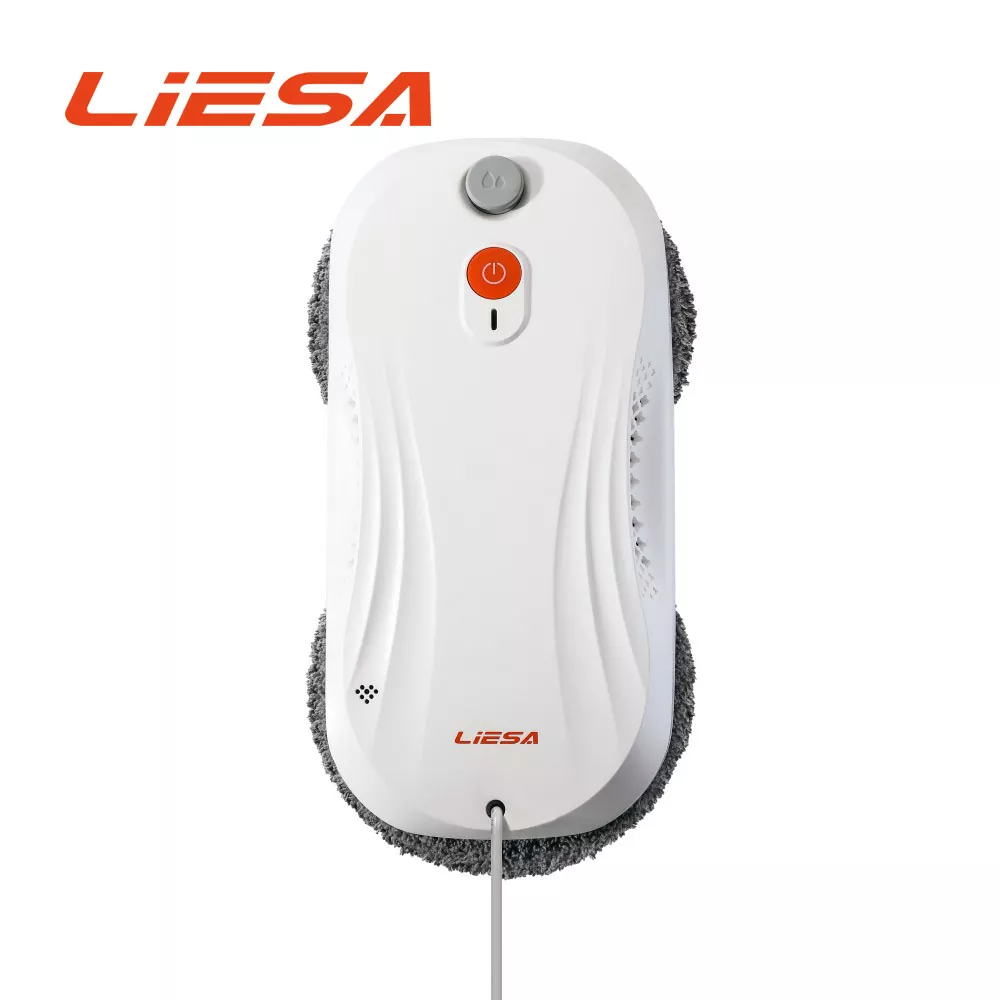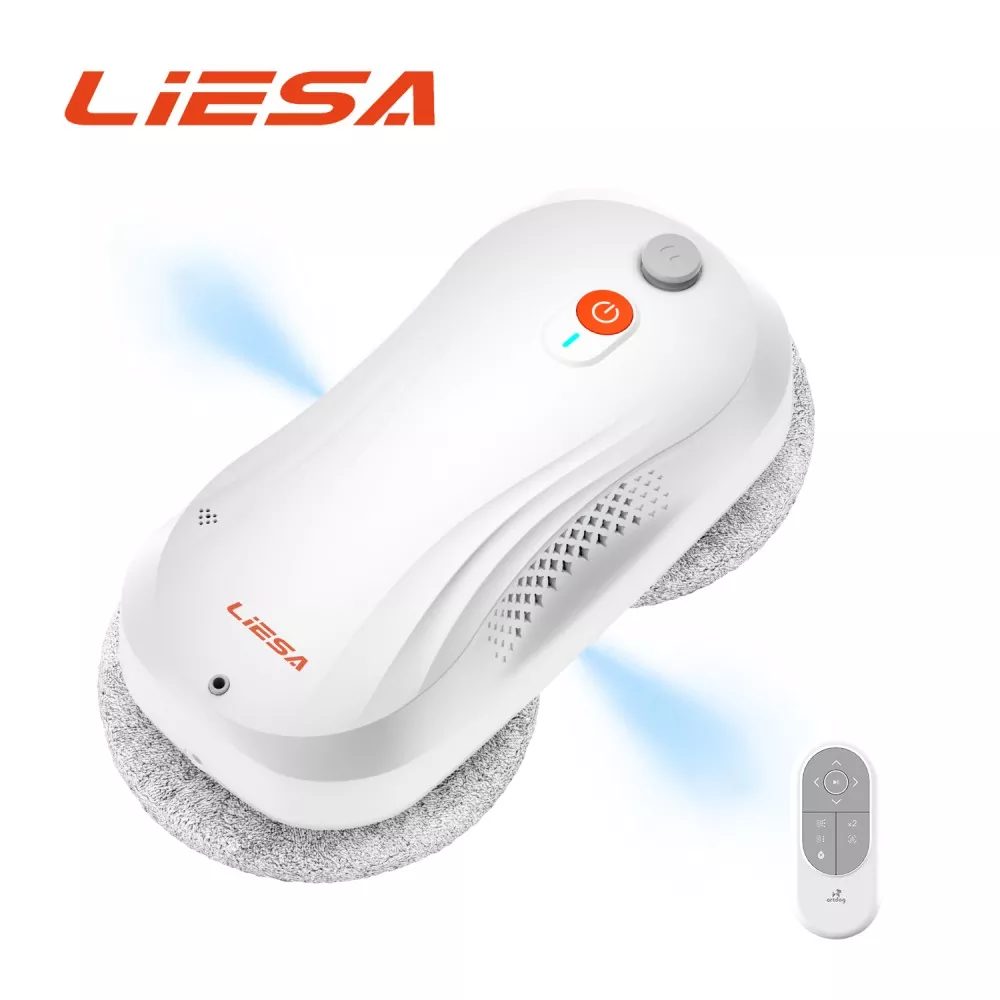
Cordless Window Cleaning Robot
Model:309 Pro
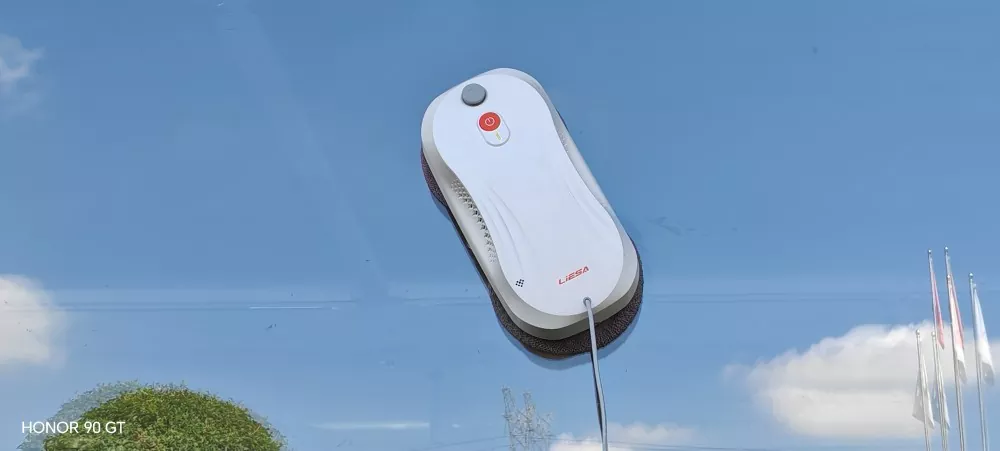
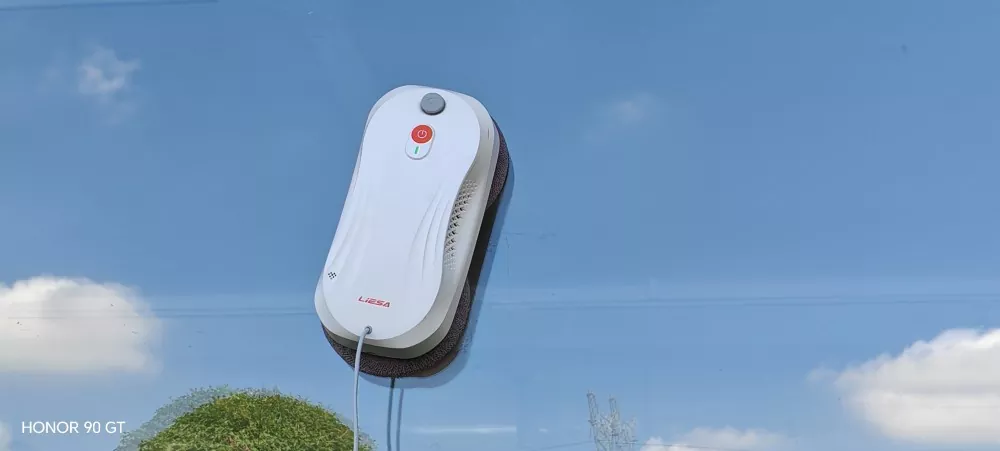
LIESA makes the cordless window cleaning robot in Qingdao, China, for panes where a mains lead is a problem: the unit runs on an internal cell, so no cable crosses the glass. Adhesion comes from a vacuum pump and is monitored by pressure sensing, and a safety rope is anchored before each run. Liesa Intelligent Technology has built cleaning appliances in Qingdao since 2014, with OEM branding.
A cable on a window robot is more than an inconvenience. It has to be routed away from the glass, it can be caught by a curtain or a handle, and it decides where the machine can work. The cordless window cleaning robot offered by LIESA, a professional manufacturer in China, removes that constraint: the cell carries the pump and the drive for the length of a cycle, and the operator places the unit where the pane needs cleaning rather than where the socket is.
Cordless operation changes the safety logic as well, and the arrangement should be understood before purchase. Adhesion is still generated by the vacuum pump and monitored by pressure sensing, and the safety rope is still anchored before the run, because a cell does not remove the need for a mechanical backup.
What the Cell Has to Carry
Two systems draw current on a window robot: the vacuum pump that holds the body to the glass and the drive that moves it. A cordless model therefore has to size its cell around suction duty rather than around a motor rating alone, which is why runtime is always quoted per model and per suction level.
Placement and duty cycle then decide how far one charge goes. A single balcony pane is a short cycle; a full set of windows is several cycles, and the cordless window cleaning robot is docked or charged between them. Whole-house cleaning usually requires
Specifications
| Overview | Model | 309 PRO | |
| Product Name | Cordless Window Cleaning Robot | ||
| Color | White / Pink | ||
| Appearance (Design Rendering) | |||
| Packing List | Main Unit (with built-in battery pack) × 1, Power Adapter × 1, AC Power Cord, DC Extension Cord × 1, Cleaning Cloths × 8, Safety Rope × 1, Remote Control × 1, User Manual × 1, Spray Bottle × 1, Battery × 1 | ||
| Detailed Specifications | |||
| Package | Color | White / Pink | |
| Main Unit Dimensions (L×W×H) mm | 269*136*78 | ||
| Main Unit Material | ABS+PC | ||
| Main Unit Net Weight (kg) | 1.18 | ||
| Overall Gross Weight (incl. 1-in-1 Master Carton, kg) | 2.45 | ||
| Color Box Dimensions (L×W×H) mm | 320x86x287mm | ||
| 1-in-1 Master Carton Dimensions (L×W×H) mm | 335x96x315mm | ||
| 5-in-1 Master Carton Dimensions (L×W×H) mm | 505x350x335mm | ||
| Function | Operating Mode | 1. Clean Upwards 2. Clean Downwards3. Clean Leftwards 4. Clean Rightwards 5. Spot Cleaning6. X1 Mode Cleaning (Dry/Wet Mopping; adjustable water volume for wet mopping—Small/Large—with Small as default) 7. X2 Mode Cleaning (Dry/Wet Mopping; adjustable water volume for wet mopping—Small/Large—with Small as default) | |
| Backup Battery Charging Time (h) | Approx. 2.5 hours | ||
| Backup Battery Runtime (min) | 20–30 minutes | ||
| Operating Noise (dB) | Approx. 68 dB | ||
| Operating Temperature & Humidity Range (°C / %) | 0–40°C; ≤85% RH | ||
| Operating Speed (min/m²) | Approx. 4 min 40 sec per square meter; one full water tank covers 18 square meters | ||
| Rated Power (W) | 72 W | ||
| Rated Voltage (V) | 24 V | ||
| Unit Lifespan (h) | ≥400 Pa | ||
| Suction Motor Speed (rpm) | 29,000 RPM ±10% | ||
| Speed Settings | Automatic Adjustment | ||
| Vacuum Pressure (Pa) | 2000–3200 RPM (Variable Frequency) | ||
| Manual Update (Firmware) | Yes | ||
| Low Battery Alarm | Yes (Buzzer) | ||
| Control Method | Remote Control (2.4G) — Controllable range: up to 25 meters | ||
| Minimum Working Surface Size (cm) | 30*30 | ||
| Water Spray Settings | 2 Levels | ||
| Water Spray Volume (ml/spray) | Small Setting: Approx. 0.06 ml/s; Large Setting: Approx. 0.09 ml/s | ||
| Water Spray Method | Atomizing Nozzle (Bi-directional Spray) | ||
| Water Level Detection | None | ||
| Applicable Surfaces | Glass, tiles, wooden doors, marble walls, and other smooth vertical surfaces | ||
| Structure | Solenoid Valve | Voltage | 24V |
| Indicator Light | Battery Indicator / Meaning of Indicator Light Colors | Yes | |
| Water Tank | Capacity (ml) | 60 ml | |
| Motor | Suction Motor Type | Brushless DC Motor | |
| Drive Wheel Motor Type | Brushed DC Motor | ||
| Battery | Battery Capacity (mAh) | 650 | |
| Battery Type | Lithium-ion Cells | ||
| Charging Current (mA) | Approx. 300 (at constant current) | ||
| Accessories | Adapter | Output Parameters: Voltage (V), Current (A) | 24V 3A |
| Input Parameters: AC (V), Frequency (Hz), Current (A) | AC 100–240V, 50/60 Hz, 2.5A | ||
| Safety Rope | Safety Rope Load Capacity (Kgf) | 150 | |
| Safety Rope Length | 5 m | ||
| Cleaning Cloth | Quantity | 8 Blades | |
| Other | Sensor | Distribution and Category | 1. 6-axis sensor (on the mainboard) 2. Barometric pressure sensor (on the button board) |
| Certification | CE | YES | |
| KC | YES | ||
Power Arrangements Compared
| Arrangement | How it behaves | Where it suits |
| Mains cable only | Constant power, cable on the glass | Fixed pane beside a socket |
| Mains with backup hold | Constant power, cell holds after a cut | High-rise and commercial glass |
| Cordless with dock | Cable-free, charged between cycles | Moving between many windows |
| Cordless with spare cell | Cable-free with a second pack | Whole-house cleaning in one session |
The rows differ in where the power comes from and where the cable goes, not in cleaning performance, because the pads, spray and suction platform are shared across the range.
Charging Habits and Cell Care
Cell life in a window robot follows the same rules as other cordless appliances: charge it after use rather than storing it discharged, keep it out of direct sun on a balcony, and follow the storage charge recommendation in the manual. A cell kept at low charge for months loses capacity faster than one kept topped up.
The dock, where supplied, doubles as the storage position, which is what keeps the habit going. Units left in a cupboard are the ones that are found flat when they are wanted, and a dock beside the window turns charging into part of putting the cordless window cleaning robot away.
OEM and Order Notes
The cordless window cleaning robot is supplied as OEM work on body colour, logo, carton artwork, manual language, charging configuration and battery capacity. Runtime and suction levels are confirmed on pre-production samples, and spare cells or docks are quoted with the first order. Minimum order quantity, tooling and lead time are confirmed with the quotation.
Contact: Liesa Intelligent Technology (Qingdao) Co., Ltd., Qingdao, China | www.liesagadget.com. Factory address and full contact details are provided with the quotation.
FAQ
Q: How long does the cordless window cleaning robot run on one charge?
A: Runtime depends on the suction level and the size of the pane, and the figure per model is given on the specification sheet because the vacuum pump is the main load on the cell.
Q: Is a cable needed at any point?
A: Only for charging. The cycle itself runs on the cell, which means no lead crosses the glass and the unit can be placed anywhere on the pane.
Q: Is the safety rope still required on a cordless model?
A: Yes. The rope is anchored before every run, because a cell does not replace the mechanical backup behind the monitored pump and the backup hold.
Q: How should the cell be stored?
A: Charged after use rather than left flat, out of direct sun, and at the storage charge stated in the manual.
Q: Can one charge cover a whole house of windows?
A: Several small panes may be covered, but a full set of windows normally needs either a dock for charging between panes or a second cell.
Q: What is needed to quote?
A: The market, charging configuration, battery capacity, runtime requirement, colour, quantity and packaging format.
Send Inquiry
Contact Info
-
Address
No.1, Keyuan Wei 1st Road, Laoshan District, Qingdao City, Shandong Province, China
-
Tel
-
Email
Welcome to our website! For inquiries about our products or pricelist, please leave your email to us and we will be in touch within 24 hours.
Related Products


News Recommendations